

Emergency Medicine Residency
-Erica Ogle DO, EM Resident
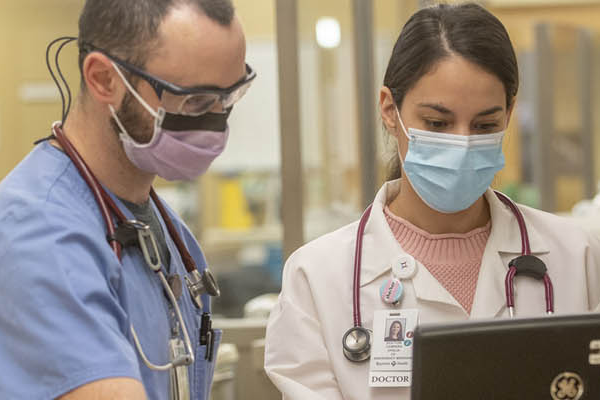
All the Experience You Need with 122,000+ ED Visits a Year

The best way to learn emergency medicine is by treating a lot of sick patients.
Because Baystate Medical Center is the region's tertiary referral center—and one of the highest volume emergency departments in the northeast—you will be exposed to a broad range of pathologies and advanced procedures. Our ED sees approximately 230 patients per day on average, with a high percentage of ESI Level 1 & 2 patients (high acuity).
We are a 3 year emergency medicine residency in beautiful western Massachusetts. Baystate Medical Center is a Level 1 adult and pediatric trauma, STEMI, and stroke receiving center.
Our Sane Schedule Lets You Balance Work and Life
We care that our residents have a life outside of the emergency department.
While you are here, you are going to work hard. But you will also have time to enjoy yourselves and pursue your interests. Our structured curriculum supports your wellness. It's why clinical assignments average less than 45 hours per week. Shifts usually do not exceed 9 hours, and night shifts are scheduled in short blocks of 4-5 shifts in a row at most.
Top-Notch Training, Top-Flight Facilities
- Our ED has 10 ambulance bays and a rooftop helipad, 94 private rooms, dedicated radiology suite, and plenty of work stations.
- We emphasize ultrasound in critical care. Our program focuses on helping you master bedside emergency medicine ultrasound and satisfy ACEP credentialing guidelines.
- Our ACS-accredited simulation center helps you prepare for difficult cases using simulations of actual scenarios seen in our ED.
- Train to deliver care in challenging conditions experienced in under-served parts of the world with our International Emergency Medicine Program.
Personal Perspectives
Hear from our program leadership, chief residents and current residents.
Wellness Designed from the Ground Up
- Our monthly VITALS meeting (formerly called Wellness and Resiliency Club) is a time for Residents and Attendings to wind down and discuss important topics such as how to create a CV, how to negotiate your contract, and what to do if a physician is needed on an airplane.
- Trivia nights will test your random knowledge and give you bragging rights in the department.
- The annual resident retreat allows you to bond with your fellow residents and escape the hustle and bustle of the ED.
- We've recently implemented a mid-year retreat which serves as a check-point for you to bond with your class and combat burnout, prepare for the job search, and target training-specific issues.
The Emergency Medicine Residency at UMass Chan Medical School-Baystate is ACGME-accredited.
Program-at-a-Glance
Meet Our Team


Residency Program Director
Adam Kellogg, MD
adam.kellogg@baystatehealth.org
Associate Program Director
Bryanne Macdonald, MD
bryanne.macdonald@baystatehealth.org
Associate Program Director
Jennifer Bolton, DO
jennifer.bolton@baystatehealth.org
Associate Program Director
Patrick Felton, MD
patrick.felton@baystatehealth.org
Associate Program Director
Liza Smith, MD
liza.smith@baystatehealth.org
Residency Administrator
Kathleen Diederich
Department of Emergency Medicine, S5426
413-794-5999
kathleen.diederich@baystatehealth.org
By the Numbers
Program Metrics
- Number of years: 3-year program (PG1-3)
- Number of residents: currently PG1, 16 | PG2, 16 | PG3, 16
Department Metrics
- Yearly census: 122,000+ visits
- 25% pediatrics | 29% admissions | Five Level 1 trauma cases per day
- 34 full-time board-certified faculty
- ED ultrasound, pediatrics, research, administrative, international & wilderness medicine fellowships
- Baystate Medical Center: 780-bed facility, Level 1 Trauma Center, and pediatric hospital
Curriculum Summary
- Scheduled shifts: 45 hours per week in ED with graded responsibility
- Conferences: five hours per week didactic, morning report, monthly journal club
- PG1: EM (twelve weeks); pediatrics/pediatric ED (eight weeks); orientation, CCU, MICU, anesthesia, , trauma, ophthalmology/EMS, vacation (four weeks each); obstetrics/gynecology, orthopedics/ultrasound (2 weeks each)
- PG2: EM/Pediatric EM (36 weeks), PICU, SICU, elective, vacation (four weeks each)
- PG3: EM/Pediatric EM (40 weeks), elective, community ED, vacation (four weeks each)
Resident Life
Benefits & Facilities
We have attempted to maintain salaries in the 75th percentile nationally, and here in western Massachusetts, we enjoy a lower cost of living than in major urban areas. View our complete list of salaries and benefits.
- Four weeks of vacation per year, meal subsidy, free parking
- Disability/malpractice/health/dental/life insurance
- ED residents’ lounge with department library and computers
- Three-day yearly resident retreat
- National/regional conferences
- Membership: EMRA (Emergency Medicine Residents’ Association), ACEP (American College of Emergency Physicians), AAEM (American Academy of Emergency Medicine)| Subscription:
- Annals of Emergency Medicine
- Baystate Medical Center library, health club, procedure simulation lab
Enjoy Life Outside of Work
We recognize that life exists outside the hospital and beyond the scrubs. Experience all that our area has to offer!
Emergency Medicine Residency Facilities and Resources
State-of-the-Art Emergency Department
Our new Emergency Department boasts state-of-the-art equipment and plenty of work space.
Highlights include:
- 10 ambulance bays and helipad
- 3 trauma bays
- 94 beds
- 24/7 open pediatric emergency department
- dedicated pediatric resuscitation room
- 17 pedi rooms
- locked psychiatric unit
- 78,000 sq ft.
- 180 computers
Emergency Ultrasonography
Our ultrasound program focuses on helping you master bedside ultrasound for the purposes of improved patient care and research.
Our department has six ultrasound machines. Exams are stored on a central archive in the ED via a wireless network, which tracks them for patient care, teaching purposes, and resident credentialing.
You’ll begin your ultrasound training during your intern orientation month, and then participate in a radiology month during your first year. During this month, you’ll dedicate time to learning ultrasound and satisfying ACEP (American College of Emergency Physicians) credentialing guidelines for emergency ultrasound.
Through lectures and hands-on scanning time, you’ll become proficient in emergency medicine applications including but not limited to: FAST, AAA, cardiac, gallbladder, early and late pregnancy, renal, DVT, vascular access, and procedural guidance. We place special emphasis on ultrasound in critical care.
Contacts:
Gavin Budhram, M.D.
Chief, Emergency Ultrasound Division
ACS-Accredited Simulation Center
Simulation is a dynamic, hands-on teaching tool that allows you to learn the necessary procedural and cognitive skills in a critical real-life environment without risk to patients or staff.
The ACS-accredited Baystate Simulation Center is an onsite 1,200 square-foot facility with three state-of-the-art simulated patient rooms. Our curriculum is designed to help you gain experience with critical-case presentations in a controlled environment.
Simulation Center
You’ll be scheduled for a simulation scenario four to five times a year. We also can simulate actual scenarios that you’ve seen in the Emergency Department to allow you the opportunity to practice difficult cases.
Simulated Patient Rooms and Debriefing
Each simulated patient room is equipped with a realistic mannequin simulator and video-recording capabilities. Recording simulation sessions allows us to have an instant debriefing after each simulation.
Procedure Boot Camp
During intern orientation, you’ll participate in our Procedure Boot Camp and practice procedures on simulation task trainers to better prepare for residency.
Resident Lounge and Other Resources
We provide our residents with a residents’ lounge in the administrative area of the Emergency Department.
The lounge contains:
- Six networked computers with access to a scanner and printer
- Reference textbooks
- Secure lockers
- Department mailboxes
- Comfortable furniture for relaxing
We also provide you with:
- A private sleeping room for nights spent on-call or downtime between shifts
- Reserved, secure physician parking lots for all house staff
- A health club facility on Baystate grounds
We Are Baystate EM
@baystateem
Equity, Inclusion, and Belonging

Western Mass: A Great Place to Live and Learn
Back to Top