

Stroke Outcomes
Our team of stroke specialists are dedicated towards providing the best care possible for you or your loved one experiencing stroke.
How We Measure Stroke Outcomes
To measure stroke outcomes, we track important factors like complication rates, recovery, need for extra care, and survival. We compare our results with national benchmarks to make sure we provide quality care and keep improving.
As part of the stroke certification process through Joint Commission, we are required to report outcomes related to interventional procedures.
24-Hour Post-Procedure: 0.02% Stroke or 0.005% Death Rate at Baystate Medical Center
Diagnostic cerebral catheter angiography is a procedure that helps find blockages, aneurysms, and other problems in the brain. During the procedure, a Neuroendovascular surgeon puts a thin, flexible tube into an artery and guides it up to the brain. A contrast dye is injected, and X-rays are taken to get clear pictures of blood vessels in the brain.
The Joint Commission recommends that the rate of stroke and death within 24 hours after a diagnostic cerebral catheter angiography should be 1% or less.
Baystate Medical Center has a 0.02% stroke and 0.005% death rate for January 2025 to December 2025.
Endovascular Therapy (EVT) Success Rates
When treating certain types of strokes, doctors use a procedure called mechanical thrombectomy to remove blood clots from brain vessels and restore blood flow. A system called Thrombolysis in Cerebral Infarction (TICI) is used to measure how well this treatment works. We track these scores to measure the success of endovascular stroke treatments.
- TICI 2B means that more than half of the affected area is receiving blood flow again.
- TICI 3 means the blood vessel is completely open, with full blood flow restored.
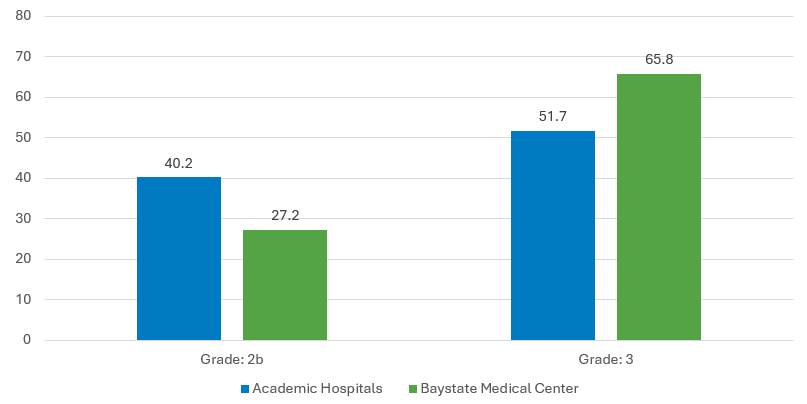
From January 2025 to December 2025, Baystate Medical Center had a 27.2% for TICI 2B, slightly lower than the 40.2% reported by other academic facilities around the United States.
During that same timeframe, BMC had a 65.8% for TICI 3, higher than the 51.7% reported by other academic facilities.
There are no recommended percentages for TICI 2B or TICI 3, but the higher percentage, the better.
TICI 2B and TICI 3 Measures
Back to Top