

Peripheral Artery Disease Warning Signs, Risk Factors, and Treatment
This article was reviewed by our Baystate Health team to ensure medical accuracy.
 Mohammed Irfan Ali, MD
Key Takeaways
- Most leg cramps are harmless, often caused by muscle overuse, stress, or dehydration, and can usually be relieved with stretching, massage, or heat/cold.
- Peripheral arterial disease (PAD) is a serious blood flow condition that can sometimes be mistaken for leg cramps but causes pain with activity, not at night.
- Smoking is the strongest risk factor for PAD, and other risks include diabetes, high blood pressure, high cholesterol, and kidney disease.
- PAD symptoms range from leg pain while walking to non-healing foot sores, coldness, numbness, or color changes in the legs.
- Early diagnosis and management—including lifestyle changes, medications, and in severe cases surgery—can prevent progression and reduce the risk of heart attack, stroke, and limb loss.
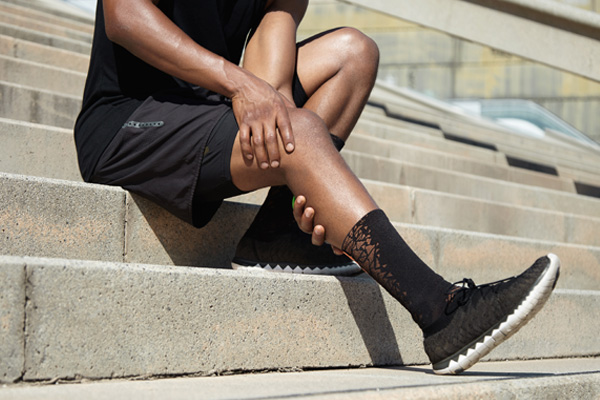
For Dr. Mohammed Irfan Ali, a vascular surgeon at Baystate Vascular Services, treating patients with peripheral artery disease (PAD) is a daily occurrence. Despite having a mortality rate higher than that of strokes and many common cancers, most of Dr. Ali’s patients have never heard of PAD, and more concerning, they often dismiss symptoms as common signs of aging.
Hidden in Plain Sight: The Overlooked Threat of PAD
According to Dr. Ali, PAD occurs when plaque buildup narrows the arteries that supply blood to the legs, and in some instances, the arms.
“It helps to think of your body as a house and the arteries in or leading to your legs as plumbing,” he explains. “As your house ages, sludge and rust build up in the plumbing. As the buildup grows, water pressure drops, and, eventually, the pipe fully clogs. When a clog occurs in the body’s plumbing, blood, oxygen, and nutrients can’t reach the tissue and cells in the legs and feet, leading to symptoms ranging from pain and even tissue death.”
Common symptoms of PAD include:
- pain, cramping, or fatigue in the calves, thighs, hip, or buttocks when walking or being active that eases when you rest
- numbness
- slow-healing sores on the feet
- pain or burning in the feet or toes while lying flat, and often at night
- a weak or absent pulse in the legs or feet
- change in skin color and/or temperature
“Many patients with PAD symptoms mistakenly assume they have a minor leg or foot problem,” says Dr. Ali, “when in reality, their symptoms may point to very serious health risks such as strokes, heart disease, and cardiovascular disease.”
Further, Dr. Ali notes, unrecognized and untreated PAD can require amputation of the foot or lower leg.
What Raises Your PAD Risk
While anyone can get PAD, it is most common in people over age 50, and in individuals with certain risk factors.
As Dr. Ali explains, “PAD-risk factors fall into two camps: things you can change, and things you can’t. The more risk factors you have, the greater your chances of developing PAD, which is why it’s critical to address the things you can. For example, smoking and diabetes both restrict blood flow. Quitting smoking and getting diabetes under control can prevent PAD from developing, slow its progress, and provide symptom relief.”
| Things you can't change | Things you can control |
|---|---|
| Being over 50 years old, especially with other heart risk factors | Smoking |
| A family history of PAD, heart disease, or stroke | Diabetes |
| High blood pressure | |
| High cholesterol | |
| Being overweight or obese |
Diagnosing PAD
Diagnosing PAD involves a combination of physical exams and imaging to detect narrowed arteries and blockages and determine how far the disease has progressed. It’s not uncommon for patients to undergo one or more diagnostic procedures.
Diagnostic options for PAD include:
Ankle-Brachial Index (ABI)
A quick, non-invasive test, ABI compares blood pressure in the ankle to blood pressure in the arm. If the pressure in the ankle is lower than that in the arm, it indicates that blood isn’t flowing properly. The results of the test will reveal to what degree—if at all—you have PAD.
Duplex Ultrasound
A non-invasive diagnostic test that uses sound waves to create real-time images of blood vessels. It can detect narrowing and blockage of vessels as well as assess blood flow.
Angiography
An imaging technique that involves injecting patients with a contrast dye allowing physicians to visualize the inside of blood vessels, map blood flow, and spot blockages.
There are three principal types of angiographies used for PAD, each with its own advantages and applications. These include:
- CT Angiography: Uses a combination of radiation and iodine to create detailed, 3D images of arterial anatomy and blood flow. Not recommended for people with kidney issues.
- MR Angiography: Provides detailed, 3D images of blood vessels and blood flow using magnets and a contrast agent. Ideal for soft tissue exploration and patients who can’t tolerate radiation, but not an option when certain metal implants are present.
- Catheter Angiography: Sometimes referred to as digital subtraction angiography (DSA), this minimally invasive X-ray procedure uses a thin tube (catheter) inserted into a blood vessel near the suspected blockage. A contrast dye is injected through the catheter to create a digital image. Using a computer, doctors digitally subtract or remove bone and tissue to create a high-definition image of blood vessels and blood flow. In some cases, DSA can serve to diagnose and treat PAD as surgeons may use the same catheter access to remove plaque, open arteries, or place stents.
Treating PAD
Treatment options for PAD are truly personalized based on an individual’s overall health and conditions present, lifestyle habits, and the extent and progress of their PAD.
“The goal of any PAD treatment,” says Dr. Ali, “is to improve blood flow and reduce the risk of complications. Depending on the severity of the patient’s condition and overall health, treatments range from non-invasive lifestyle changes to advanced therapies using drug-coated devices implanted in the body.”
Treatment offered at Baystate Vascular Services include:
Lifestyle Changes
Recommended lifestyle changes include:
- Quitting Smoking: The benefits of quitting smoking—including cigarettes, cigars, and vapes— on PAD symptoms are significant and almost immediate. Twenty minutes after quitting, both your blood pressure and heart rate decrease. The level of nicotine—a chemical that constricts blood flow—drops to zero in 24 hours.
- Losing Weight: Losing weight—even a small amount—reduces strain on your circulatory system, improves blood flow, and aids in managing risk factors like high blood pressure and cholesterol.
- Exercise Therapy: A crucial, first-line treatment for PAD, exercise therapy increases blood flow and reduces leg pain. While you can undertake an exercise program on your own, a supervised, interval-based walking program done under the care of a professional for roughly 60 minutes, 3+ times a week, is considered the ‘gold standard’ for PAD treatment.
Medication
There are several medications that can help improve blood flow and reduce the risk of blockages. These include:
- Antithrombotic Therapy: Using medications that prevent platelets from sticking together and clots from forming, this therapy reduces the risk of PAD and symptoms, as well as stroke, heart attack, and other vascular disorders.
- Lipid Management: As high cholesterol is closely linked to PAD, statins—medications that lower LDL ("bad") cholesterol—are often prescribed to patients.
Minimally Invasive Procedures for PAD
These treatments use catheters guided through your blood vessels to open blockages without the need for large incisions. Depending upon its location, the catheter may be inserted through the groin (femoral), arm (brachial), or wrist (radial). Using the catheter access, one of several devices may be introduced at the site of the blood vessel narrowing or blockage. These include:
- Angioplasty: A small balloon inflated inside the artery to open narrowed areas.
- Stent: A small, metal mesh-like tube implanted to keep narrow or blocked arteries open
- Chronic Total Occlusion CTO (CTO): Specifically used for dense fibrous plaque that completely blocks an artery. CTO involves inserting a specialized guidewire to drill though the blockage
- Subintimal Tracking: In instances where the blockage can’t be penetrated, a wire is inserted between the blockage and the vessel wall (the subintimal space) and then back into the center of the vessel, where a balloon or stent may be used to open the vessel
- Intravascular Lithotripsy (IVL): In cases where the arteries are stiff and heavily calcified, standard balloon angioplasty may be difficult or impossible, and IVL may be the best option. IVL involves inserting a specialized balloon catheter into the affected part of the artery. The balloon has tiny emitters that generate sonic pressure waves that create small cracks in the blockage, without harming the artery. Once the blockage is reduced to tiny pieces, a balloon or stent can be inserted.
Advanced Drug Technology Therapies for PAD
A recent advancement in balloon and stent treatments involves using the devices to not only open the blockage, but to also deliver medication directly to the artery walls.
- Drug coated balloons: The standard balloon is coated with a medication that transfers to the artery wall when the balloon is inflated and remains in place when the balloon is deflated. The medication, an anti-scar drug, keeps the vessel from narrowing.
- Drug eluting stents: When ballooning fails, a drug-coated stent may be used to prop the artery open while slowly releasing medication over weeks to months to prevent the buildup of scar tissue
Advanced Techniques for PAD.
- Complete Endovascular Reconstruction of the Aortic Bifurcation (CERAB): In some cases of PAD, the body’s main artery (the aorta) becomes blocked where it splits, or forks, in the abdomen to carry blood to both legs (the aortic bifurcation). Complete endovascular reconstruction restores blood flow by using stents placed through small groin punctures to create a new smooth Y shaped inner lining that restores better blood flow into both legs.
- Endovenous Bypass: An alternative to major surgery, this technique uses catheters, wires, and stent grafts to route blood from a healthy artery segment through a blockage and into a nearby vein below the blockage. It works to restore blood flow, relieve pain, help wounds heal, and avoid amputation.
- Deep Venous Arterialization (DVA): Reserved for patients with severe PAD, the arteries near the foot can be so damaged that blood cannot reach the toes. DVA creates a “detour” so blood is diverted around the blockage and into a deep vein toward the tissues not reached by the artery.
- Limb Flow Procedure: Designed for patients with severe PAD and facing amputation of the foot when other procedures have failed, this technique creates an entirely new route for blood to reach the limb. This is achieved by making small punctures (usually at the groin and near the ankle) and using catheters and imaging to connect a working artery above the blockage to a deep vein below it that normally carries blood up towards the heart. Special tools are used to redirect blood flow in the vein, so blood flows down to the foot instead of up and away.
Hope and Progress: Why Early Diagnosis Matters
While PAD is a chronic condition, it is manageable, and, as Dr. Ali notes, ongoing treatment advancements offer significant hope for improving quality of life and preventing amputation.
“Thanks to new technologies and approaches, patients today have a much lower risk of a serious cardiovascular event and a much greater chance of successfully managing PAD,” says Dr. Ali. “The key is recognizing symptoms when they occur. The earlier we address it, the better the chances for preventing disease progression, reducing mortality, and preserving mobility and quality of life.”
Beyond the Blockage: Transforming Peripheral Artery Disease (PAD) Treatment
Back to Top