

Hypertrophic Cardiomyopathy: A Doctor’s Story & What to Know
This article was reviewed by our Baystate Health team to ensure medical accuracy.
Colby Salerno, DOKey Takeaways
- Hypertrophic cardiomyopathy (HCM) is relatively common and often underdiagnosed, affecting about 1 in 500 people; many individuals have mild or no symptoms, which can delay detection.
- HCM is a genetic heart disease characterized by abnormal thickening of the heart muscle, which can impair the heart’s ability to relax, fill, and sometimes pump blood effectively (obstructive vs. non-obstructive forms).
- Symptoms are variable and can be intermittent or absent, but commonly include shortness of breath, chest pain, dizziness or fainting, palpitations, and reduced exercise tolerance; in rare cases, it can lead to dangerous heart rhythms and sudden cardiac death.
- Diagnosis relies on cardiac imaging and family history, with echocardiography as the primary test, supported by ECG, cardiac MRI, and sometimes genetic testing for patients and relatives.
- Treatment ranges from medications to advanced therapies, including beta blockers, calcium channel blockers, and newer targeted drugs (e.g., mavacamten), with severe cases requiring interventions like implantable devices or heart transplantation.

When most people look back on their tween years, they recall their biggest concerns centered around friends, sports, and school. Not so for Colby Salerno. What he remembers most clearly is getting diagnosed with hypertrophic cardiomyopathy (HCM).
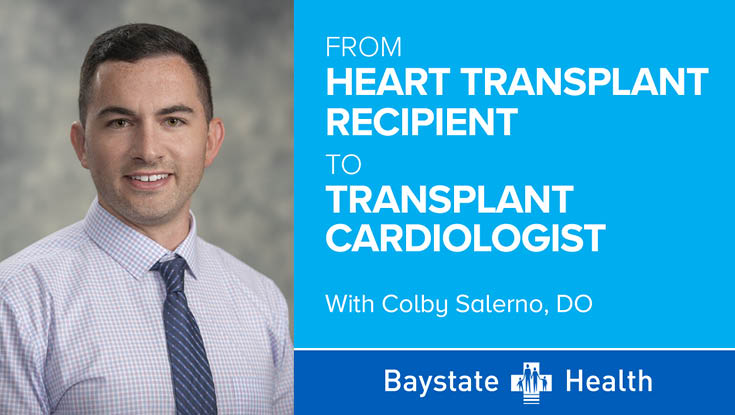
Now an advanced heart failure and transplant cardiologist and director of the Hypertrophic Cardiomyopathy Clinic at Baystate Health, Colby Salerno, DO, brings his personal experience to every patient encounter.
A Journey From Heart Transplant Patient to Cardiologist
“I was first diagnosed with HCM at the age of 12 and got my first defibrillator at 14,” recalls Dr. Salerno. “Aside from no sports, I led a pretty normal life. I finished high school and went to college with hopes of becoming a doctor. All was good until my senior year of college, when I developed symptoms and learned my only path to survival was a transplant.
“I still feel the weight of that news on my parents and me,” he says, “I remember how the doctor gave us time alone to process it as a family before diving into the next steps. I didn’t know it then, but that action of granting us that moment of grace and respect would become something I now strive to provide all my patients facing tough diagnoses and choices.”
While Dr. Salerno’s classmates went off to pursue first jobs and discover new places to call home, he spent the next six months in the hospital in the company of other people who were also in need of a heart transplant.
“It was challenging, it was scary, and it was frustrating,” he says. “I lived hooked up to IVs and monitors. I walked for exercise when I could, I decorated my room to be my own, and basically did what I could to remain hopeful. But there’s no getting around how stressful and emotionally challenging the uncertainty of the whole situation was.”
After six long months, Dr. Salerno received the call that changed everything—there was a heart waiting for him. Two years later he realized his dream of going to med school. Just seven years after that, he completed an advanced heart failure and transplant fellowship.
“Yes, I’m a doctor now,” he says, “but as someone who's had a heart transplant, I’ll never stop being a patient. Even now, I get regular stress tests in the lab I oversee. There’s lifelong follow-up and daily medication. Some might see this as a burden, but I see it as an opportunity to bring genuine empathy to every patient I meet. I’m not just prescribing treatment plans; I’m living it alongside my patients.”
Understanding Hypertrophic Cardiomyopathy: What It Is, Who’s at Risk, Symptoms, and Diagnosis
As is the case with many HCM patients, Dr. Salerno and his family had never heard of HCM until he was diagnosed.
“Just because HCM isn’t well-known doesn’t mean it’s rare,” he says. “It affects about 1 in 500 people in the general population. Many people who have it don’t know it, either because they have no symptoms or mistake them for something else, so the true number may be higher.”
What is Hypertrophic Cardiomyopathy?
HCM is a type of heart disease where the heart muscle becomes abnormally thick, usually in the main pumping chamber (the left ventricle). This thickening makes it harder for the heart to relax and fill with blood. In some cases, it can partially block blood leaving the heart, making the heart work much harder than it should.
Dr. Salerno adds, “There are two types: obstructive and non-obstructive. In obstructive HCM, the thickened heart muscle—usually the wall between the lower chambers—partly blocks the main outflow pathway from the left ventricle to the aorta, so blood has a harder time getting out with each heartbeat.
“In non-obstructive HCM, the heart muscle is still abnormally thick and stiff but doesn’t significantly block blood leaving the heart. However, the stiffness still causes problems.”
Who Is at Risk for Hypertrophic Cardiomyopathy?
HCM often runs in families and is considered a genetic condition. It can appear at any age, though many cases show up in young adulthood or middle age. It affects men and women equally.
What Causes Hypertrophic Cardiomyopathy?
In most cases, HCM is caused by changes in certain genes that control how heart muscle cells grow and function. These genes cause the heart muscle cells to grow thicker than they should, especially in the main pumping chamber.
What Are Common Symptoms of Hypertrophic Cardiomyopathy?
Dr. Salerno notes that the variability of symptoms of HCM makes diagnosing it difficult.
“Not only do symptoms range dramatically—from shortness of breath to a racing heart, but they can also come and go. Very often, this leads to delayed diagnosis as people assume whatever caused their symptoms have been resolved. And in some cases, a patient may experience no symptoms at all.”
Common symptoms include:
- Shortness of breath, particularly during activity or when climbing stairs
- Chest pain or chest pressure
- Feeling lightheaded, dizzy, or fainting with exertion
- Rapid, pounding, or fluttering heartbeat
- Tiring more easily than expected during sports or physical activity
In a small number of people, the thickened heart muscle can trigger dangerous heart rhythms that cause the heart to suddenly stop. The risk for ‘sudden death’ is higher in certain groups, with risk factors that we screen for.
How Hypertrophic Cardiomyopathy is Diagnosed
Diagnosis starts with a personal and family history (focusing on HCM or sudden deaths), plus a physical exam.
“From there,” says Dr. Salerno, “we move on to a series of non-invasive imaging tests.” These include:
- Electrocardiogram (ECG/EKG): A simple test that records the heart’s electrical activity and can show rhythm problems or signs of thickened muscle
- Echocardiogram (heart ultrasound): The main test for HCM; it uses sound waves to create moving pictures of the heart and shows how thick the heart walls are and how well it pumps
- Cardiac MRI: A more detailed view of the heart muscle thickness and structure when needed
In some cases, genetic testing may be used to identify the gene change linked to HCM. If appropriate, close relatives (parents, siblings, children) may also be referred for genetic testing.
“Once HCM is identified,” explains Dr. Salerno, “the next step is to identify which type—obstructive or non-obstructive—we’re looking at and move forward with treatment.”
Treatment Options for Hypertrophic Cardiomyopathy
HCM treatments range from symptom-managing medications to advanced options, including invasive procedures and, in the most severe cases, heart transplantation.
Medications for Hypertrophic Cardiomyopathy
For most of Dr. Salerno’s patients, the first medication options focus on symptom control.
“Medication choices are largely driven by the symptoms a patient has,” says Dr. Salerno. “If a patient also has atrial fibrillation, we’ll prescribe blood thinners to prevent blood clots and reduce stroke risk. If the heart’s pumping strength is low, heart failure medications may also be prescribed to improve heart function and relieve symptoms.”
Other first-line options include beta blockers and calcium channel blockers. Dr. Salerno explains:
“Beta blockers are good for slowing down heart rate, which helps relax the heart muscle and reduces chest pain. If beta blockers don’t work, we typically turn to calcium channel blockers to slow heart rate and, again, reduce symptoms.”
He adds, “For a long time, symptom control medications were pretty much the only option. But thanks to advancements in care, we now have medications that directly target and treat the heart muscle. Mavacamten and Aficamten work by reducing how hard the heart muscle squeezes. As the heart muscles calm, blood flows more easily out of the heart, obstruction is reduced, as are symptoms like dizziness and shortness of breath.”
He adds that many patients feel better almost instantly. “We monitor their progress with echocardiograms monthly and have found that, in some cases, the obstruction is gone in just four weeks.”
Medical Device Option for Hypertrophic Cardiomyopathy
For patients with heart failure who are not responding to standard therapy, an Left Ventricular Assist Device (LVAD) may be the recommended.
A surgically implanted, battery-operated mechanical pump, an LVAD assists the heart's main chamber (left ventricle) in circulating blood throughout the body. It’s most often used for patients with end-stage heart failure to improve quality of life, provide long-term treatment (also known as "destination therapy"), or it may be used as a “bridge-to-transplant therapy,” meaning it’s a temporary solution until a heart transplant becomes an option.
LVAD is most often recommended for patients with symptoms of advanced heart failure, including:
- The left side of the heart is very dilated and weakened
- The right side of the heart functions well enough to support the device
- The heart condition limits your quality of life
Unfortunately, this is rarely an option for HCM patients because their left ventricular cavity walls are too thick and the chamber size for the device is too small.
Heart Transplants for Hypertrophic Cardiomyopathy
Heart transplant as a treatment for HCM is reserved for a small group of people whose symptoms remain severe despite all other treatments.
Because donor hearts are limited, the evaluation process for determining who gets a heart is very detailed. Only patients who meet medical, surgical, and lifestyle criteria are considered good candidates.
Requirements for being considered for a heart transplant include:
- Conditions: Patients with severe heart muscle disease, congenital heart defects, or severe coronary artery disease
- Failure of Other Treatments: Patients must have exhausted all other medical therapies.
- Age Limits: While there is no strict upper limit, most recipients are under 70–74 years old
- Health Status: Patients must be free from irreversible kidney, lung, or liver disease, active infections, or severe, unmanaged medical conditions
- Psychosocial Factors: Candidates must show the ability to comply with a rigorous, lifelong, post-transplant medical regimen
- Support Network: Patients must have reliable support in the form of family and friends to help meet their mental, emotional, social, and spiritual needs after transplant
Dr. Salerno adds, “This last point is often overlooked but is critical. It’s not easy for a single person living alone to manage life post-transplant. There’s medication to be managed, you need rides to appointments, and you need to be vigilant from infection. It’s important to have your support team committed and in place well before the procedure.”
Beyond the initial recovery, transplant patients need to take daily immunosuppressant medications and participate in regular testing and monitoring.
“Many people—including myself— with HCM who receive a transplant go on to lead full, active lives,” says Dr. Salerno. “I managed to run a 5K within a year of my procedure, and I went on to get married and am now happily the father of twin boys.
“I share this so that people with a diagnosis of HCM—no matter how mild or severe—understand that, with treatment, you can get your health and life back.”
From Heart Transplant Recipient to Transplant Cardiologist
Back to Top